Published 2026-08-31. Full catalogue scan of 2026-08-30: 14,215 Bazaar resources.
Update 2026-09-02 — version boundary reached. The report below promised that the network-alias normalization would land in the paid /payable product only at an announced version boundary. As of 2026-09-02 it has: the live evaluator now maps the well-known EVM short aliases (base, polygon, base-sepolia and the like) to their CAIP-2 chain id before judging, so an alias and its eip155:* form return the identical verdict. Genuinely non-EVM rails (stellar, algorand, xrpl, cosmos, aptos, hedera) still return NOT_SPL_SETTLEMENT, unchanged. The published numbers below do not move — they were already the corrected figures, and the live evaluator now reproduces them directly rather than via a separate recompute. The response contract (schema_version 2), the frozen fixtures, and the pinned /payable/address digest 83cc0a2c… are byte-for-byte unchanged; the change was validated against the golden contract, the correctness set, and our own listings (all payable) with zero regressions.
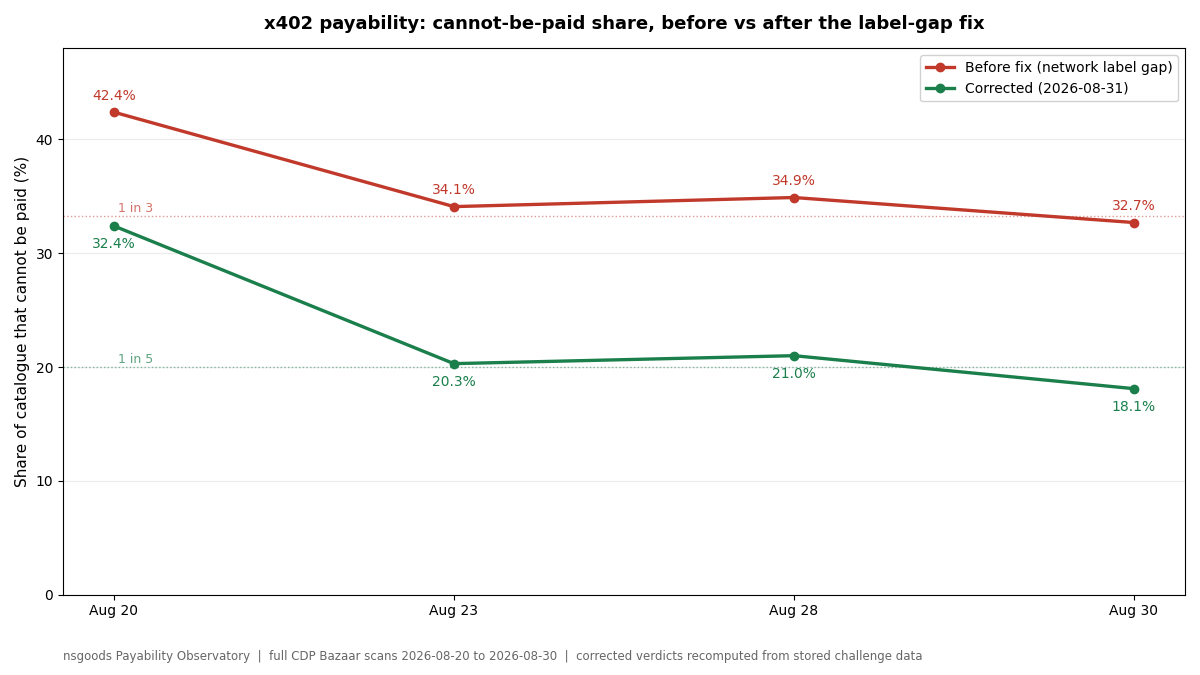
Last week we said roughly 1 in 3 listings cannot be paid. That number was inflated by a bug on our side, and we are correcting it before anything else in this report.
While running our verdicts against nohumans.directory's paid delivery data, one divergence would not die quietly. Digging into it exposed a normalization gap in our evaluator: challenges that label their network with the bare word base instead of the CAIP-2 form eip155:8453 were scored as not settleable. That gap accounted for 99.4 percent of our NOT_PAYABLE bucket, 2,074 listings across 197 hosts in the latest scan. We fixed the evaluator, mutation tested the fix, and recomputed all four full scans from the stored challenge data. Thanks to the nohumans.directory author, whose public push back started the thread that surfaced this. The full exchange and our instrument comparison are published at x402.nsgoods.org/proof/instrument-comparison.html, corrections included.
Old and new, side by side, scan of 2026-08-30: cannot be paid was 32.7 percent, corrected 18.1 percent. Scan of 2026-08-28: was 34.9, corrected 21.0. The paid /payable product is unchanged: its contract and fixtures are frozen, and this normalization lands there only at an announced version boundary.
About 1 in 5 listings cannot be paid right now (18.1 percent of 14,215 on 30 August). The robust core of that figure: about 1 in 6 listings (2,476, or 17.4 percent) cannot even present a parseable 402 challenge. After normalization, listings whose declared destination genuinely cannot receive are rare, about a dozen per scan, but they are the expensive kind of failure, for example a declared Solana option whose USDC token account does not exist.
Catalogue drift, recomputed on corrected verdicts: 2.12 percent of listings per day become materially different or disappear (window measurements 1.62 and 2.59 across 20 to 30 August). Most of that is listings disappearing outright, not verdicts flipping. Raw catalogue size overstates the live economy, and it overstates it more every day.
nohumans.directory, paying real money from the buyer side, reports roughly a third of paid spend returning nothing. Their delivery figure renders live from their database and moves as coverage widens (61.5 percent as we update this line), so cite their state page at nohumans.directory/state/paid-verification rather than any frozen number, including this one. Their number and our 1 in 5 payability figure measure different layers, but they point the same direction. Data CC-BY-4.0, cite nohumans.directory/state/the-ledger. Our verdicts against their paid then rejected rows agree on the payment gate for 87 of 89 joinable listings, 97.8 percent. Details, caveats and both divergences in the instrument comparison linked above.
One pattern worth naming: in their paid census, the never-purchased cheap tail fails more than the bought-from middle. Our liveness data cannot see purchase history, but it points the same way. The unmeasured edge of this market is in worse shape than the visible part, and every headline built on the middle understates it.
One endpoint this week returned a 402 whose JSON body and PAYMENT-REQUIRED header carry different challenges: one accepts entry labeled base in the body, 14 entries in CAIP-2 form in the header, in the same response. Nothing in the spec says which channel wins. Combined with label spelling in the wild (2,306 accepts entries in one scan spell their network as bare base), this is a protocol conversation worth having, not a bug report against any one seller.
Aggregate index, updated with corrected verdicts: x402.nsgoods.org/ata-audit/payability_index.json. Verdict recomputation was done from stored challenge data of each scan, no rescan, method and per scan tables retained with sha256. Listing level daily series remains the paid layer. Signed report manifest at /proof/index.json.